

Why Does the U.S. Fertility Rate Include 14-Year-Olds?
Can we just move the fuck away from this already?!

Last week, The Persistent published a piece I wrote exploring a wee little bug that had planted itself in my brain.
When the bug first implanted, the news cycle had been all aflutter (again) over the U.S. fertility rates. The most recent CDC data had come out, confirming a continued decline and firing up plenty of opinions and hand-wringing.
But, spoiler, my piece is not a take on the dropping American fertility rates.1
It’s about the graph below (from the U.S. Congressional Budget Office’s January report on the Demographic Outlook), leveraged in the doom and gloom discourse about plummeting American births2:
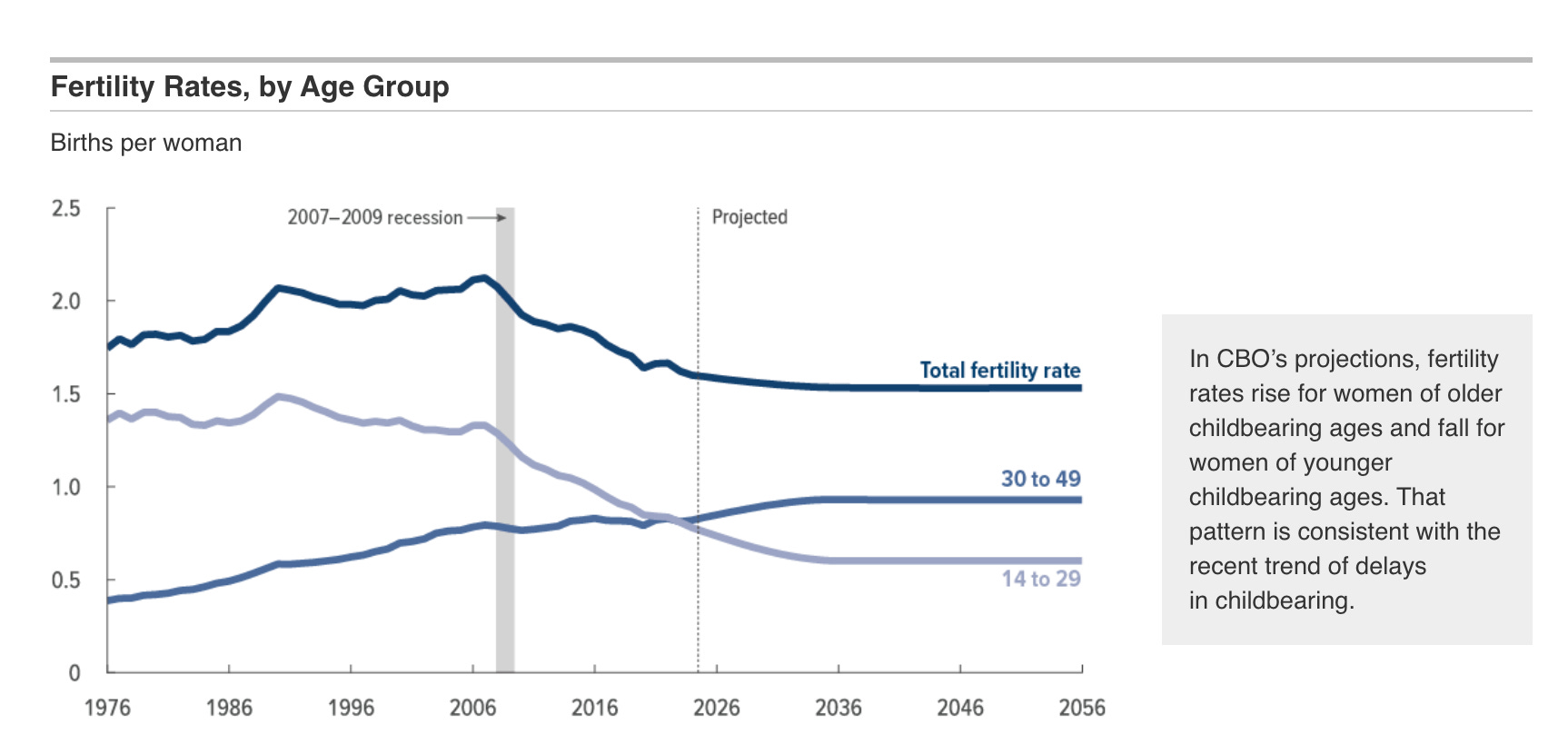
While everyone seemed to fixate on the directionality of that lighter blue line, a different point got lodged in my mind:
Why the hell does the category for “women of younger childbearing age” range from 14-29?!
FOURTEEN to 29.
Ok, fine, I understand how longitudinal data works and the need to sync up with data gathering of the past. But, c’mon, the capturing of fertility rate data for demographic reasons started in the early 1930s, when girlhood and menarche and pregnancy (and marriage) looked a smidge different. Nearly 100 years later, we should be able to reconsider these age ranges, right?
To start (and this is not a new point), one of the drivers of the dropping US fertility rate and the plunging number of births for those in the 14-29 age range is the decrease in teen pregnancies. For a thinking human, your response might be: “wait, isn’t that a good thing?” And, yes, that is an appropriate reaction. When viewed through the public health lens, teen pregnancy should decrease. No longer constrained by 1930s societal structure or cultural norms and understanding the benefits of delayed birth, the dramatic drop in teen pregnancy over the last few decades has been rightly celebrated as a huge public health win. In fact, looking very very closely at CBO data projections3, the fertility rate for 14-19 year-olds is expected to hit zero in the next ten years. ZERO. Amazing!
Now, I understand the temptation to respond to my “why the hell…” query above with a “you gotta capture all the births, no matter who is birthing” but I’m going to double down on that last point – the teen contribution to total births in this country will be negligible in the next decade. Contrast that with the vague demographic on the other end – the oldest age captured for fertility rates (written as “49” but really it is “49+”) is projected to increase in the coming years and then hold steady. Births to those 49+ are projected to surpass all births to teenagers (including 19 year-olds) by 20344. It is already far more likely today to have a 50 year-old giving birth than a 14 year-old. (Also, good chance that a pregnant 50 year-old put a lot of planning into that pregnancy while the 14 year-old… well… no imagination necessary5)
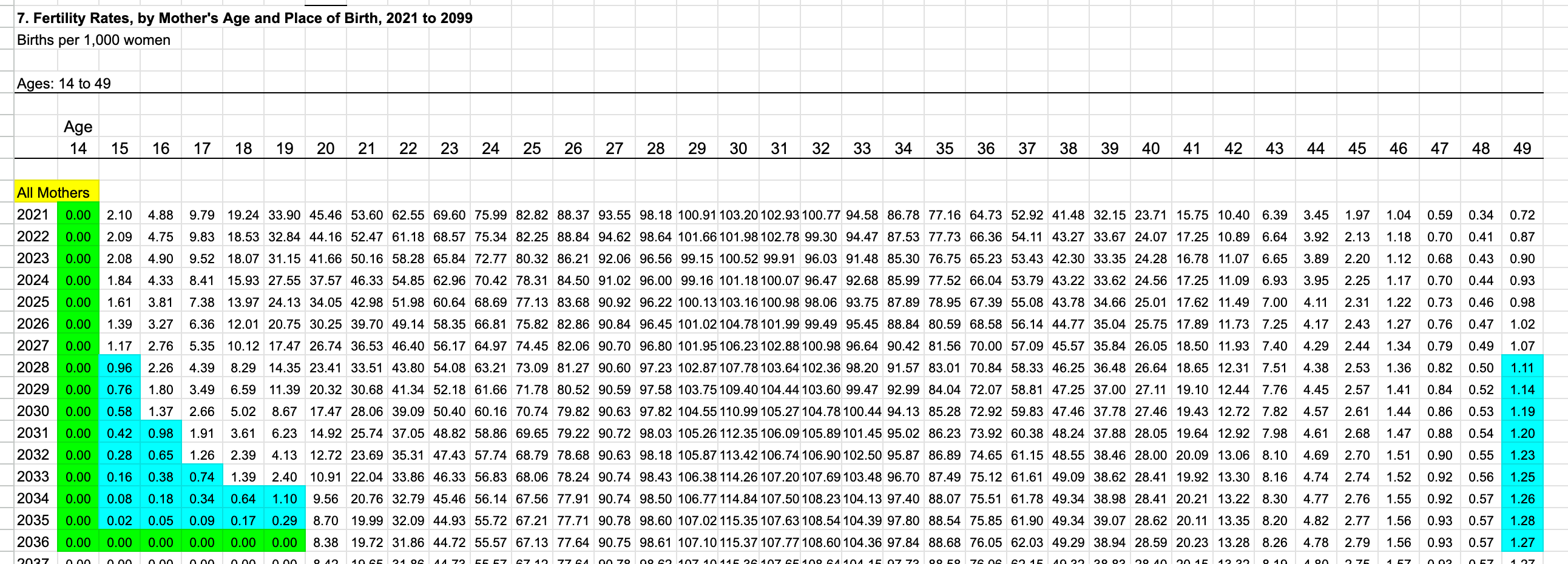
Still stuck on the ‘consistency of data’ issue? Fine, go ahead American demographers, keep capturing those negligible data points, BUT (and here is where my feathers really ruffle): change the damn language in the report.
Minor swerve: The thing that fired me up the most about this graph, and the report containing it, is not the data.
It’s the words used to describe the data.
Lumping teenagers with adults in a single “fertility rate” age bracket inevitably leads to a disconcerting language choice. Throughout the CBO report, those 14-year-olds (and 15, 16, 17) are called “women” and “mothers”. Never ever ever are they referred to as “teens”. So, I’m going to ask this again – why do we still include children giving birth to children in the *conversation* about our national fertility rate?
We should be able to move past that ‘consistency in data collection’ excuse. This is about word choice and the unnecessary inclusion of children’s bodies when capturing and discussing American breeding potential.
From The Persistent piece:
“Instead of placing teenagers into their own group, they include them in a broad demographic category called “women of younger childbearing ages.” That’s how we end up with 14-year-old girls in the same bracket as 29-year-old women.
I have a daughter who will be 14 in less than two years, which is also when these reports will be updated again. I don’t like to think of it this way, but her body will be one of those prompting the hand-wringing conversations about the loss of American breeding potential.
All of this brings me to a question that makes me queasy: Do these fertility rate demographics reflect who we, as a country, consider to be “women?” Is the female body of a 14-year-old the body of an “adult?” In the age of Epstein, it’s worth asking.”
Read the whole piece at The Persistent HERE.
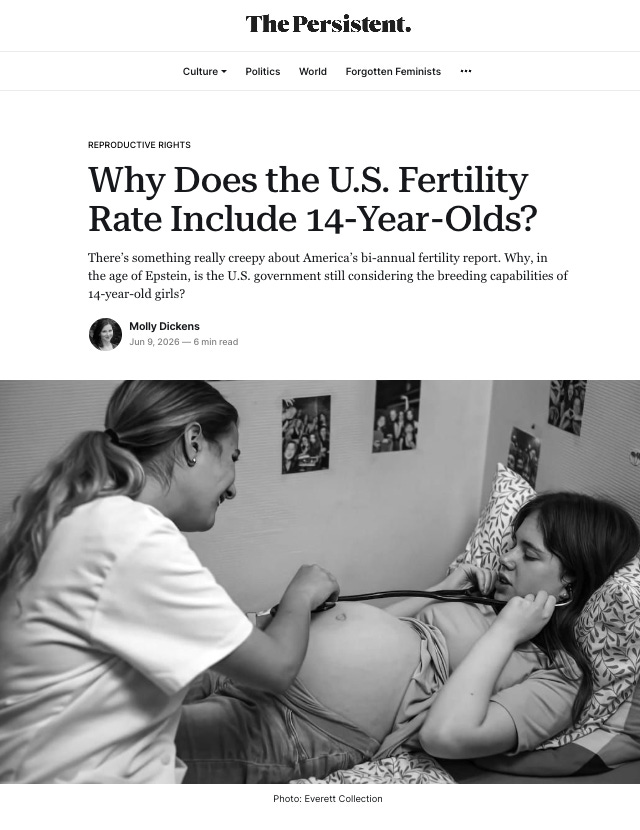
And don’t forget to SUBSCRIBE to their fantastic (award-winning!) coverage of women’s voices, stories, perspectives and ideas.
Side note — if you’re curious how any of this relates to maternal stress load, consider how language around bodies, birth, and “girls” vs. “women" seeps into the mounds of misogynistic shit piled onto us as women and parents of daughters these days:

One more thing! Can I bug you for a tiny gesture of support? A simple tap on that ❤️, a share, a recommendation, or (if you’re feeling extra generous) a ridiculously low monetary upgrade of $6 for the ENTIRE YEAR (keeps me caffeinated 😉):
With that said, I may have something brewing with Ann Somers Hogg + Lucy Hutner, MD with own new-ish thoughts on that one.
Dooms and glooms fully captured in this bit from the article:
“There were stories from NPR; CNN and The Guardian; along with Fox News, Breitbart and The Washington Examiner, which opined, and I quote, ‘if we do not fix fertility, we will cease to exist.’”
Oh yes, I even went into the supplemental data spreadsheet right here. Tab 7.
Thanks for prompting this dive Mary Anne L. Graf!
Thanks to Reshma Saujani for sharing the piece on IG/FB and opening up a whole range of comments from the justifiably appalled to the “whelp, data is data, get over it…” 😒
What the actual?! There is absolutely no public health or methodological justification for lumping children and adults together in this way. Gross.
Just...omg. Thank you for highlighting this.